
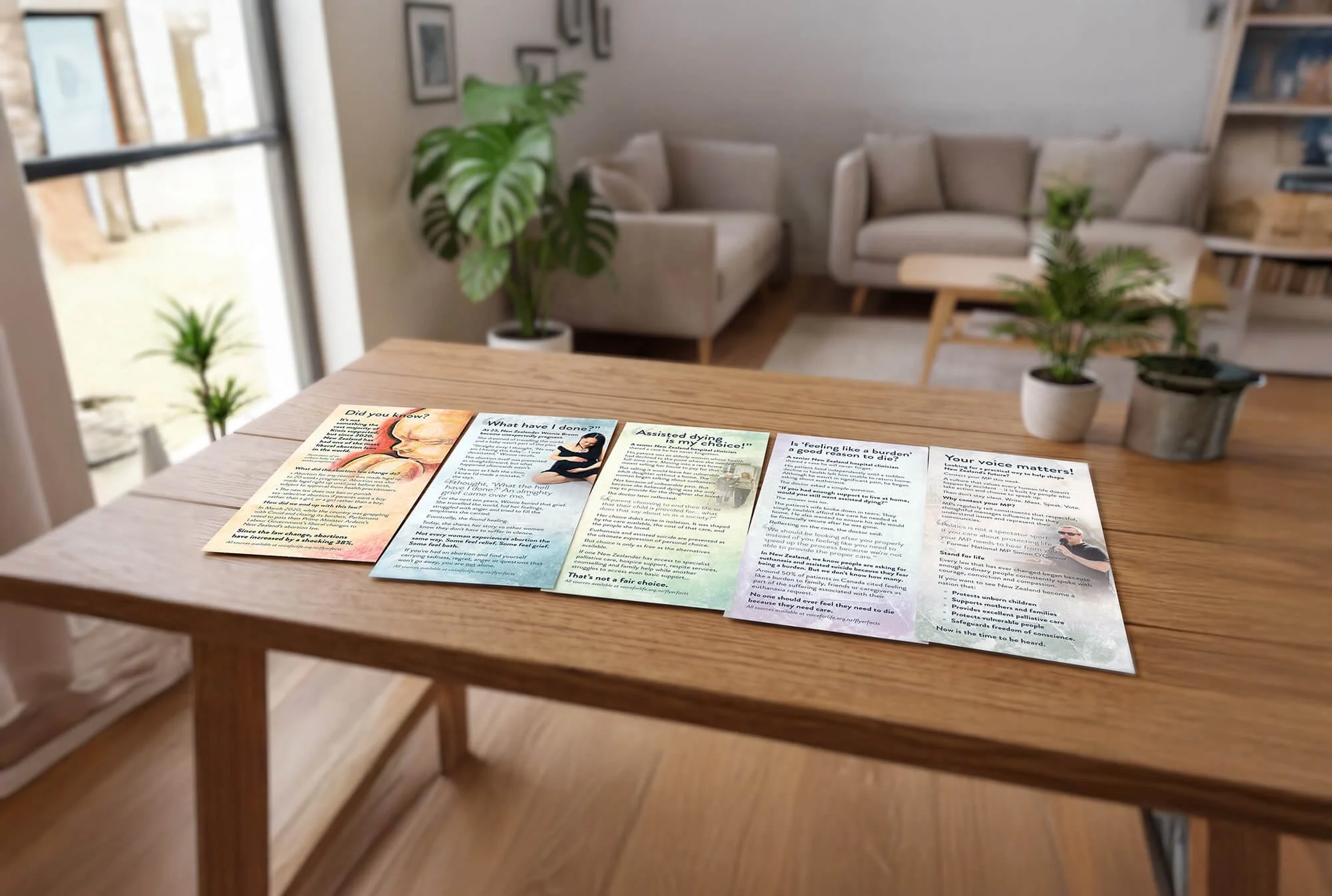
Click to see our current flyers being distributed around New Zealand.
Abortion Flyer Sources and References
Where our facts come from
The claims below appear in the order they appear on the flyer. Most of the sources are the Government’s own — the legislation, official statistics, the Ministry of Health. Several come from people who disagree with us.
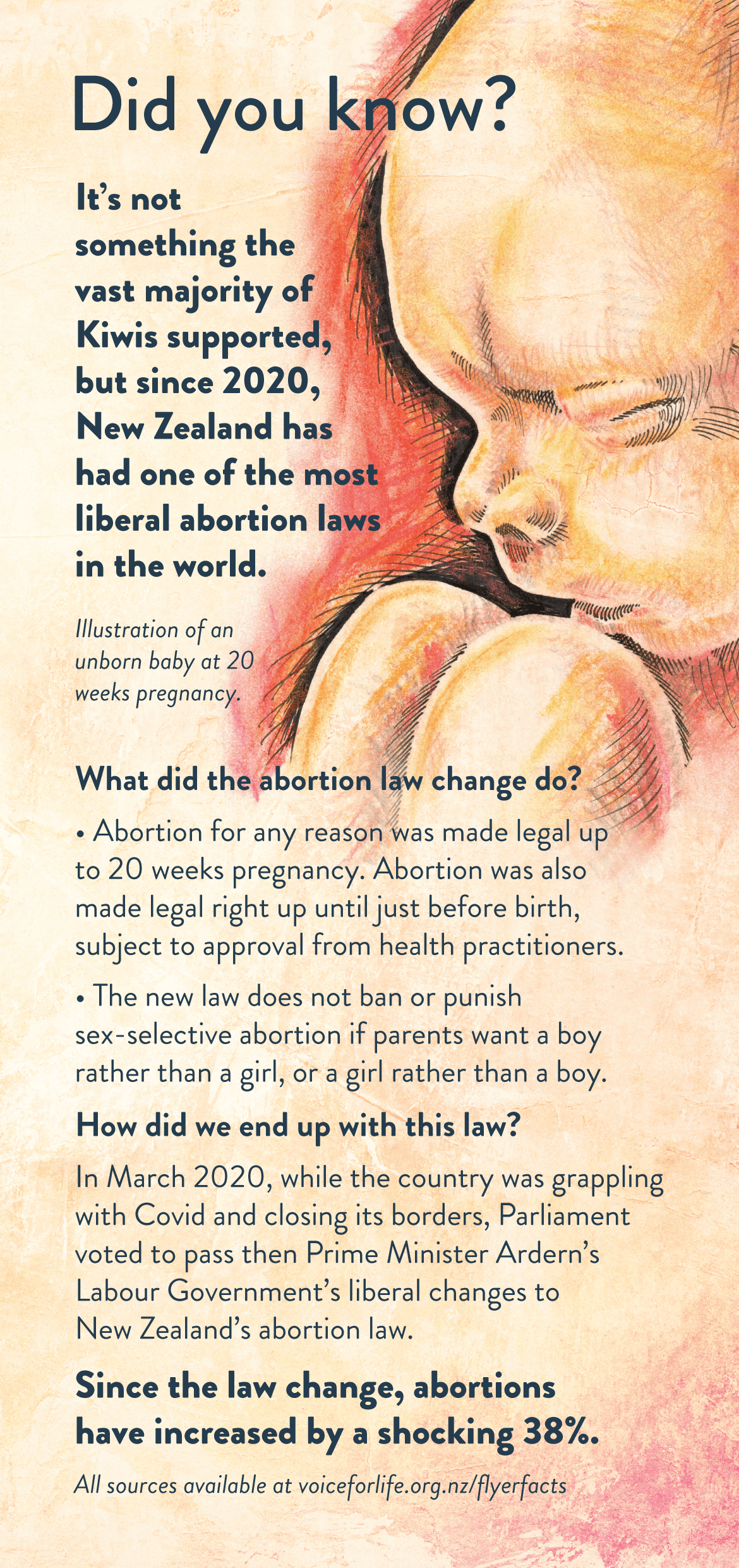
“It’s not something the vast majority of Kiwis supported”
Curia Market Research polled 1,013 eligible voters nationwide, drawn at random from 12,500 phone numbers, margin of error ±3.1%. Full results here. Asked what the time limit for abortion should be:
Only 4% supported a limit later than 20 weeks — which is what New Zealand law now permits, right up to birth.
Just 9% supported a limit of 20 weeks — the limit the 2020 Act adopted for abortion on request.
So only 13% supported a limit of 20 weeks or later. The other 87% did not.
Half wanted a limit shorter than 20 weeks; 56% of women did. The median choice was 15 weeks.
The same poll found 90% opposed sex-selective abortion, and 65% agreed that whatever their view on abortion, society should work together to reduce the number of them.
“one of the most liberal abortion laws in the world.”
Most countries stop at 12 weeks. We allow 20.
The Center for Reproductive Rights maintains the definitive global record of abortion law. Of the countries allowing abortion on request, it reports the most common gestational limit is 12 weeks. New Zealand allows 20 — eight weeks beyond the international norm.
Almost every country sets a final cut-off. We do not.
The United Kingdom stops at 24 weeks. The Netherlands stops at 24 weeks. Most of Europe permits abortion on request for 12 to 14 weeks and restricts it sharply after. The World Health Organization’s Global Abortion Policies Database records the position for every country, including our own.
New Zealand sets no ceiling at all. Since 2020 an abortion may lawfully be performed at any stage of pregnancy — at 25 weeks, at 30 weeks, at 40 weeks — provided a practitioner believes it is clinically appropriate. The best-known country in the same position is Canada, which has no criminal abortion law at all.
What the law change did
“Abortion for any reason was made legal up to 20 weeks pregnancy.”
The Abortion Legislation Act 2020 inserted a new section 10 into the Contraception, Sterilisation, and Abortion Act 1977. The Ministry of Health states it plainly: before 20 weeks there are “no clinical or statutory requirements”.
“Abortion was also made legal right up until just before birth”
Under section 11, after 20 weeks a practitioner may provide an abortion if they reasonably believe it is clinically appropriate. There is no upper time limit. DECIDE, the Government’s own National Abortion Telehealth Service, says so directly.
That it is easily done is not our description. It is the assessment of abortion rights advocates, in a peer-reviewed medical journal. Bellamak M & Paterson H, “Reconsidering post 20-week abortion in Aotearoa New Zealand”, Australian and New Zealand Journal of Obstetrics and Gynaecology, 2023; 63(5): 721–724. The grounds, they write, give practitioners “the scope to approve any abortion anyone wants and might reasonably request” — and a practitioner is unlikely ever to have to justify approving an abortion, though they may be called on to justify refusing one. The lead author writes from ALRANZ Abortion Rights Aotearoa.
“The new law does not ban or punish sex-selective abortion”
Section 21 of the Contraception, Sterilisation, and Abortion Act 1977, as inserted by the Abortion Legislation Act 2020, is headed “Abortion for sole purpose of sex selection”. It states that Parliament “opposes” it, and requires a review within five years. It contains no prohibition and no penalty. An amendment that would have banned it was voted down.
How we ended up with this law
The bill passed its third reading on the evening of 18 March 2020, by 68 votes to 51. New Zealand closed its borders to non-citizens the next day. Royal assent followed on 23 March, the law came into force on 24 March, and on 25 March the country entered Alert Level 4 and a State of National Emergency was declared.
It was a government bill, introduced by Justice Minister Andrew Little. Prime Minister Jacinda Ardern campaigned on decriminalising abortion and voted for it; on the night, Little publicly credited the change to her support. You can see exactly how every MP voted on voted.nz, which publishes Office of the Clerk records under an open licence.
“abortions have increased by a shocking 38%.”
In 2019, the last full year before the law changed, there were 12,857 abortions in New Zealand (Stats NZ). In 2024 there were 17,785 — Ministry of Health, Abortion Services Aotearoa New Zealand: Annual Report 2025. That is an increase of 38%. Provisional figures released by Health New Zealand under the Official Information Act put 2025 higher again, at 17,964.
The Ministry names its reports for the year of publication, not the year of the data — the 2025 report covers 2024. Note also that collection changed with the law: abortions before 24 March 2020 were reported to the Abortion Supervisory Committee and collated by Stats NZ; those after are collated by the Ministry of Health.
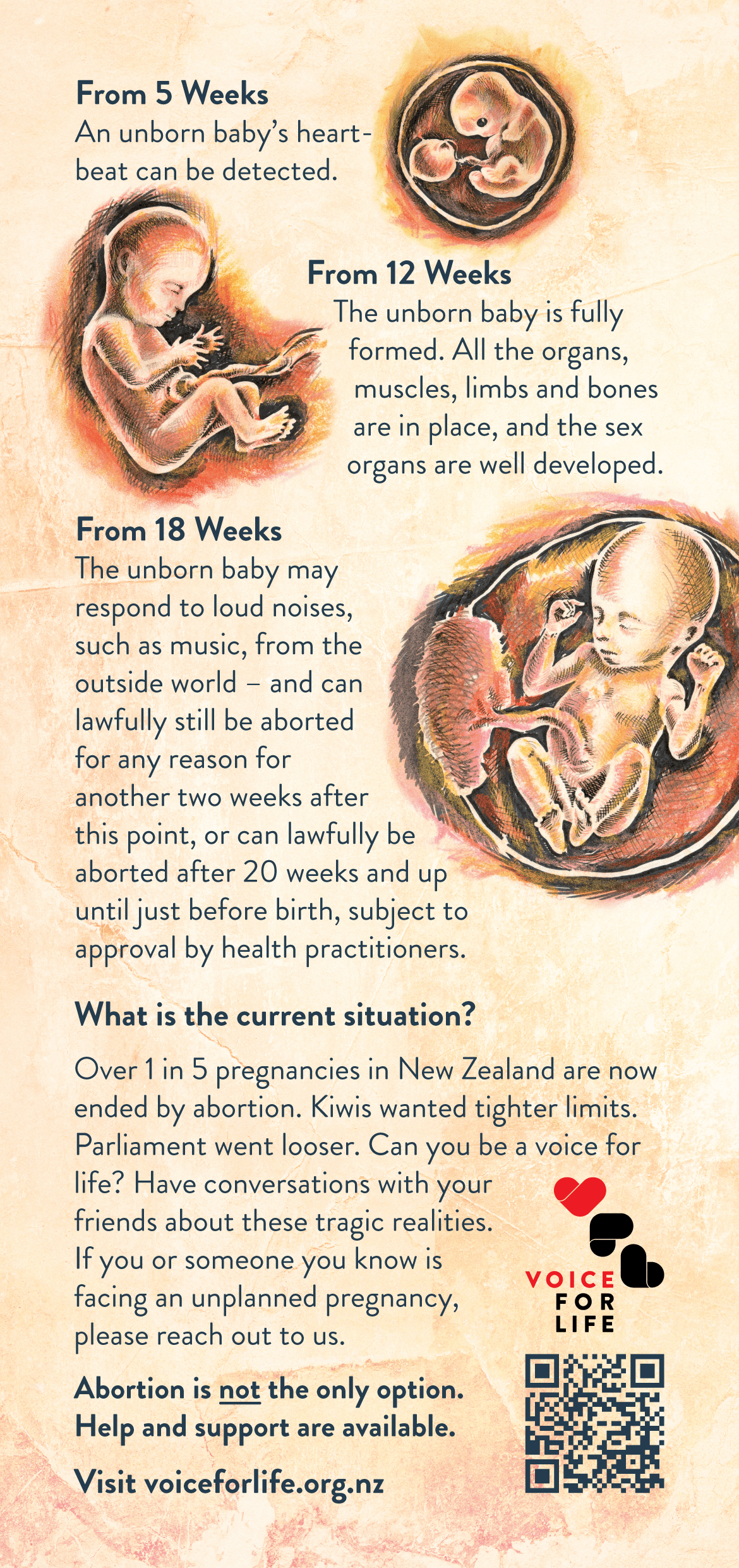
The development of an unborn baby
These are not our descriptions. They are the words used by public health services.
“From 5 Weeks — an unborn baby’s heartbeat can be detected.”
Cardiac activity can be detected on a transvaginal ultrasound from around five weeks, and consistently by six. Britten S et al., “Embryonic heart rate in normal pregnancies”, Human Reproduction, 9(12), 1994.
“From 12 Weeks — the unborn baby is fully formed. All the organs, muscles, limbs and bones are in place, and the sex organs are well developed.”
Taken word for word from Ireland’s Health Service Executive: “All the organs, muscles, limbs and bones are in place, and the sex organs are well developed.” The Australian Government’s Pregnancy, Birth and Baby service says the same, as does the Northern Ireland Public Health Agency.
“From 18 Weeks — the unborn baby may respond to loud noises, such as music, from the outside world.”
From Tommy’s, on 18 weeks: the baby will be able to hear more sounds outside your body, and may jump around to loud noises, such as music. The NHS Start for Life guide says the same. Tommy’s is the UK’s largest pregnancy charity, founded by two obstetricians at St Thomas’ Hospital, and runs its National Centre for Maternity Improvement jointly with the Royal College of Obstetricians and Gynaecologists.
What is the current situation?
“Over 1 in 5 pregnancies in New Zealand are now ended by abortion.”
There were 57,705 live births in New Zealand in 2025 (Stats NZ), and 17,964 abortions. Counting every pregnancy — births, miscarriages and abortions — abortion accounts for just over one in five. We have used the conservative figure: the Ministry’s own official measure excludes miscarriages and produces a higher number, closer to one in four.
“Kiwis wanted tighter limits. Parliament went looser.”
What Kiwis wanted: half of New Zealanders wanted a time limit shorter than 20 weeks — 56% of women did, and the median choice was 15 weeks. Only 13% supported a limit of 20 weeks or later.
What Parliament did: the Abortion Legislation Act 2020 removed the requirement for two certifying consultants, made abortion available on request with no statutory test up to 20 weeks, and removed the upper time limit entirely. Every one of those changes loosened the law. None tightened it.
Need help?
And if you or someone you know is facing an unplanned pregnancy, abortion is not the only option — help and support are available at voiceforlife.org.nz/support.
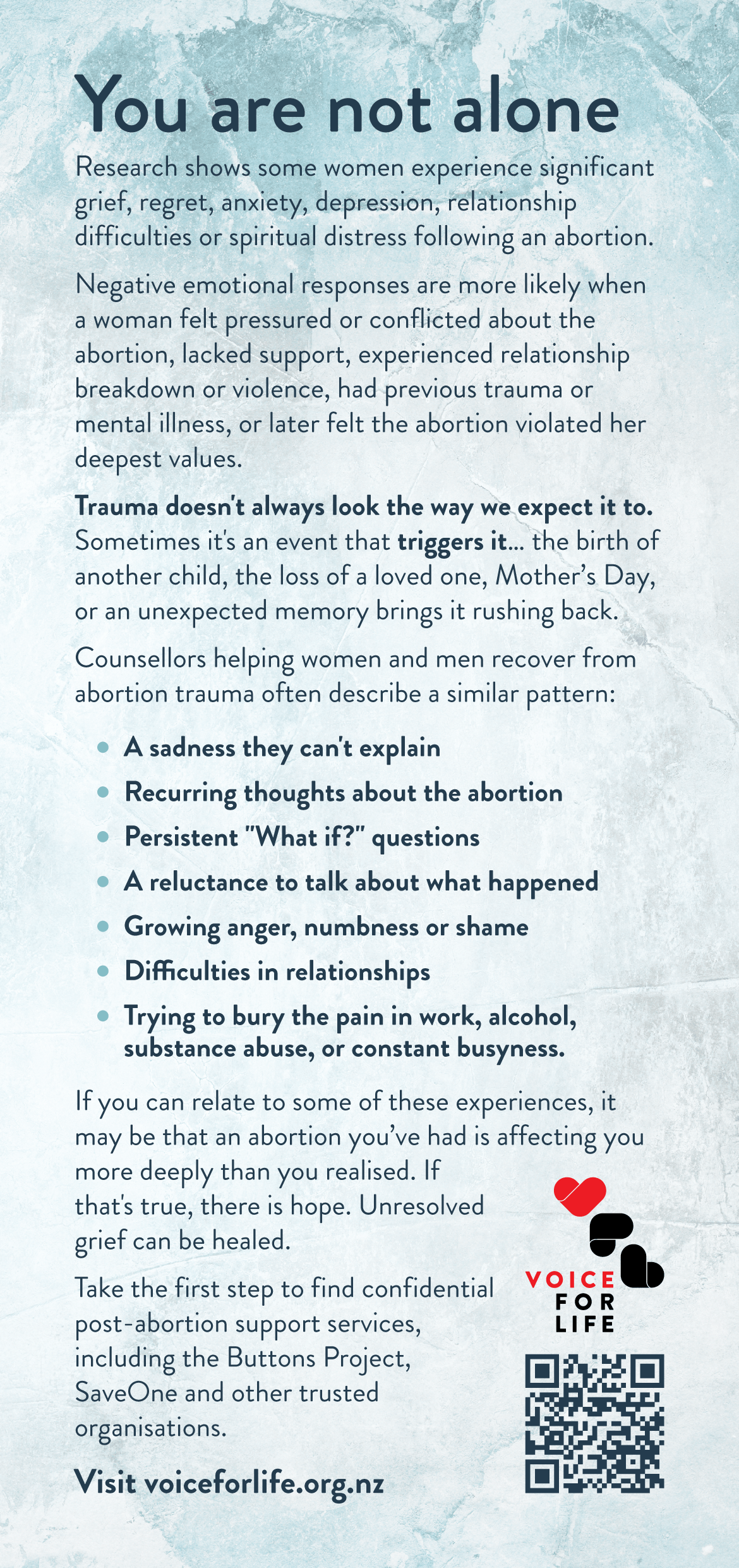
Abortion Trauma Flyer Sources and References
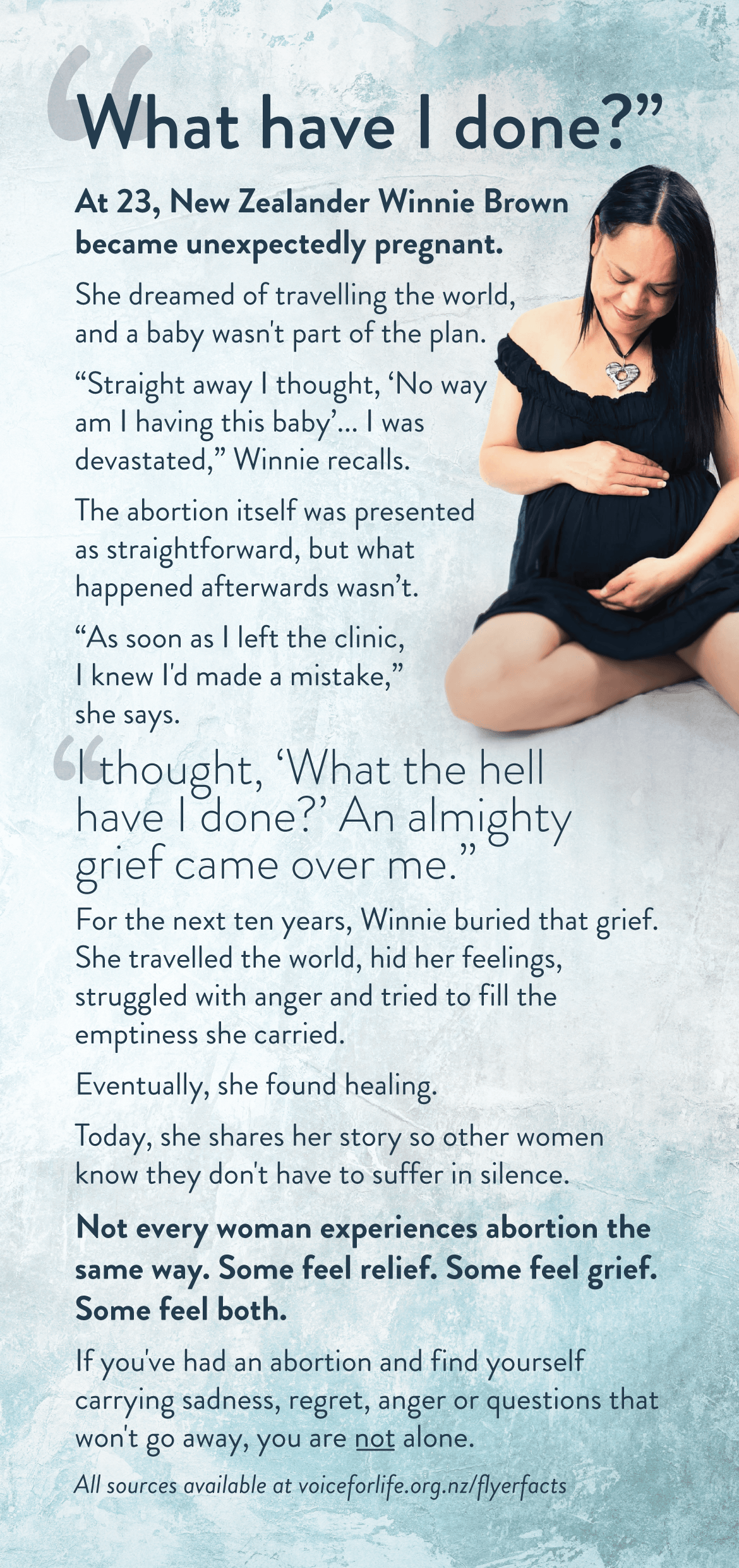
Documented personal account of Winnie Brown, "What Have I Done?" A New Zealand Woman Speaks Out About Abortion, Grief, and Choosing Life, Voice For Life.
American Psychological Association, Task Force on Mental Health and Abortion, 2008.
The Buttons Project. Provides individual support and facilitates post abortion healing programmes – www.buttonsproject.org.
Burden Flyer Sources and References
Voice For Life, Senior Hospital Clinician Speaks Out on Assisted Dying: “I Just Don’t Understand How We Got Here”, 2026.
Health Canada, Sixth Annual Report on Medical Assistance in Dying in Canada, 2024.
Health New Zealand, Review of Adult Palliative Care Services in New Zealand, 2025.
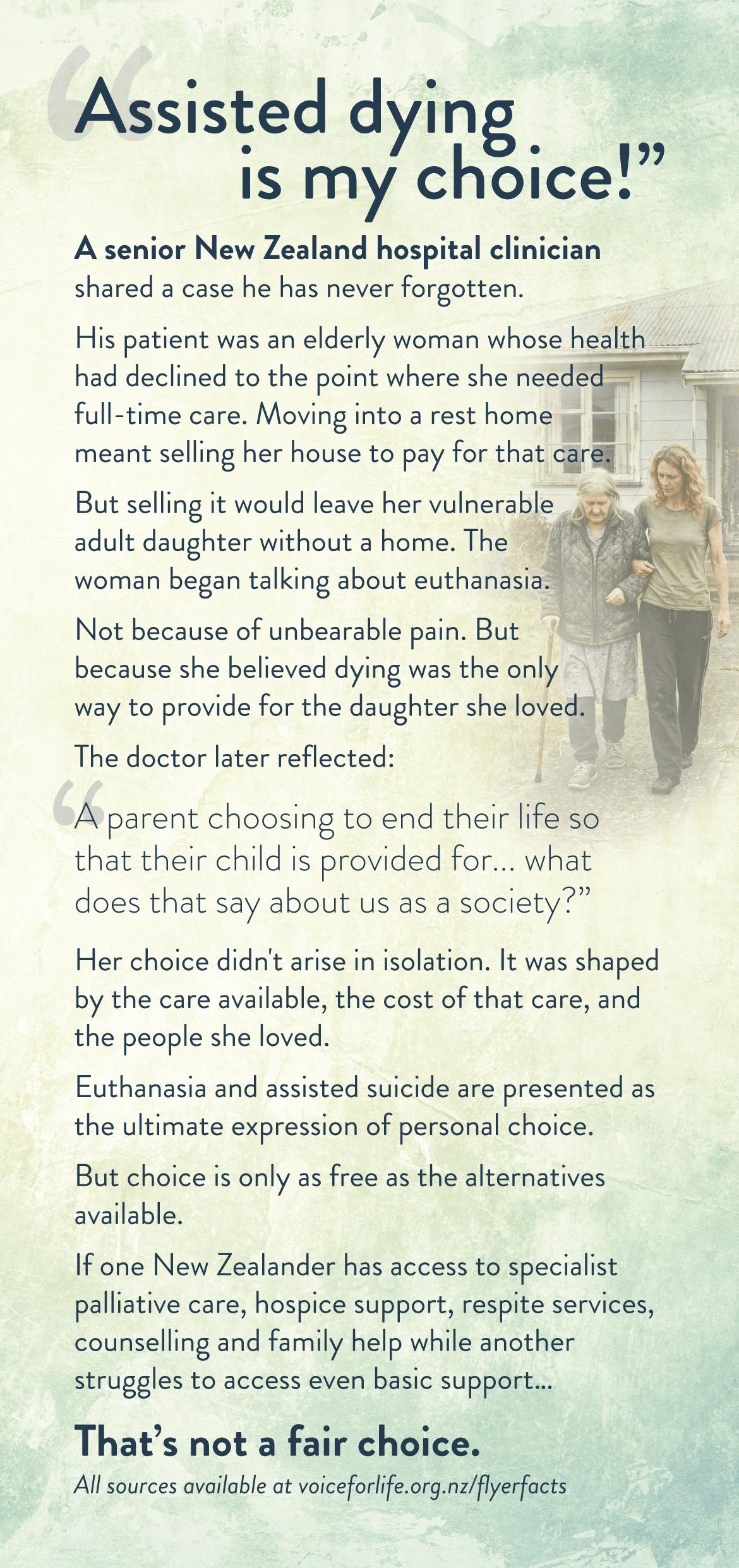
Choice Flyer Sources and References
Voice For Life, The Hidden Truth About Euthanasia: A Doctor’s Perspective, 2026.
Health New Zealand, Review of Adult Palliative Care Services in New Zealand, 2025.
Health New Zealand, Assisted Dying Service: Annual Report, 2024, Wellington.
A number of patients changed their mind when they found out about palliative care.
Health New Zealand, Assisted Dying Service: Annual Report, 2025, Wellington.1 in 5 people applying for assisted dying were not receiving palliative care.
Health New Zealand, Assisted Dying Service: Annual Report, 2026, Wellington.
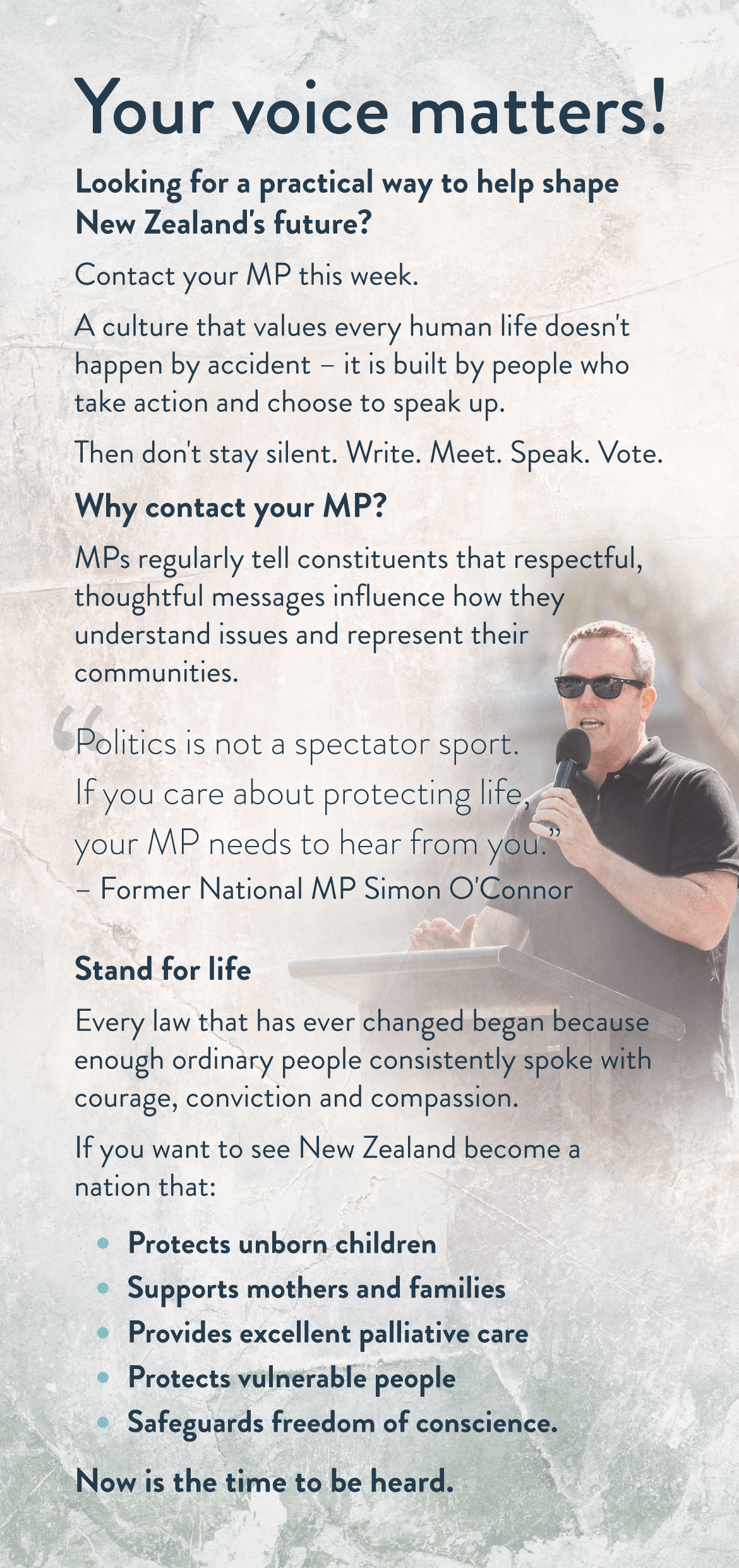
Contact Your MP Flyer Sources and References
No references or sources required.
Found something wrong?
Tell us and we will correct it.