

Framed as compassion, dignity, and choice, euthanasia has been introduced as a solution to suffering. But beneath the language and legislation lies a harder truth. A healthcare system with foundations built on “doing no harm” is now tasked with a practice that intentionally ends the lives of patients it's meant to protect.
Euthanasia is taking place in New Zealand. But it is not just a medical or legal issue, it reaches into the deepest parts of what it means to care, to be vulnerable, and to belong. It raises questions about how we treat the elderly, the sick, and those who feel like a burden. It challenges the role of doctors, the strength of safeguards, and whether true choice can exist in the presence of pressure, isolation, or unmet need.
Don’t accept the narrative, take a closer look at what assisted dying is, how it works, and the risks and realities of what is unfolding in practice.
Because how we respond to suffering says everything about who we are.
New Zealand Euthanasia Statistics
Deaths every week
0
Applicants who never even received any palliative care (1 in 5)
0
0
Deaths by the doctor's lethal injection (vs. self administered)
0
Psychiatrists left nationwide to check mental competence (there were 13!)
0
New Zealanders killed by euthanasia since November 2021
0
New Zealanders killed by euthanasia since November 2021
Deaths every week
0
Applicants who never even received any palliative care (1 in 5)
0
Deaths by the doctor's lethal injection (vs. self administered)
0
Psychiatrists left nationwide to check mental competence (there were 13!)
0
Troublesome Statistics
1) Nearly three-quarters of cases involve people over 65.
Euthanasia is overwhelmingly impacting the elderly — a group already vulnerable to isolation, dependence, and pressure.
2) The majority occur in homes or care facilities.
Decisions are being made in environments where vulnerability, dependence, and subtle pressure can exist.
3) One in five applicants is not receiving palliative care.
Some are choosing death without first accessing the support designed to ease suffering.
4) Psychological assessments are very rare.
The rarity shows that relying on referrals to protect vulnerable people is not working in practice.
5) Increasing significantly year-on-year.
Euthanasia threatens to become a new normal.
When Safeguards Aren't Enough
Serious concerns are mounting about who is protected – and who isn't.
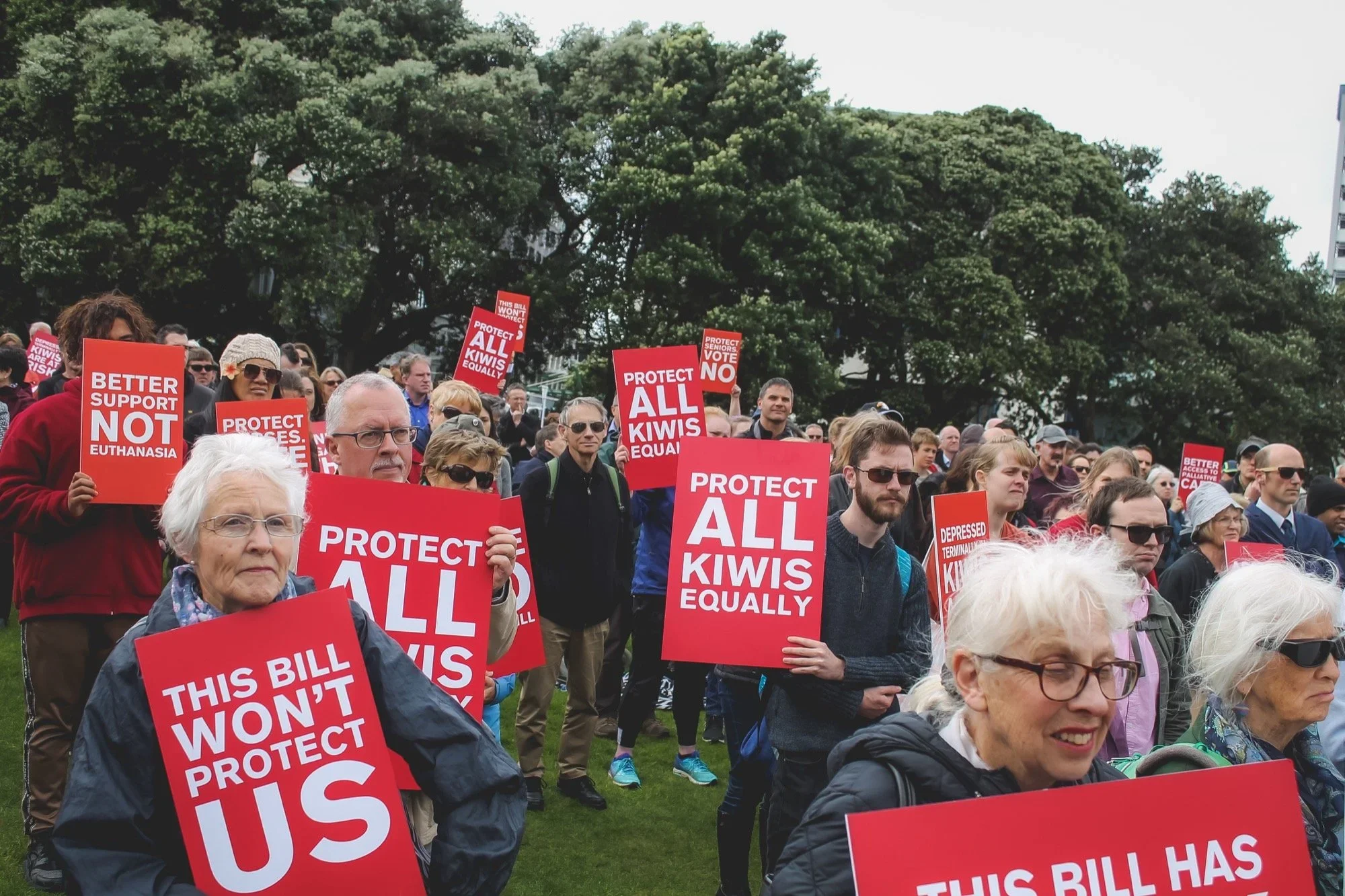
The dangers of euthanasia
Euthanasia and assisted suicide are having a far-reaching and deeply concerning impact throughout New Zealand.
Across healthcare, the elderly, people living with disabilities, and the legal system, serious issues are emerging that challenge the safety, ethics, and long-term consequences of euthanasia and assisted suicide.
From growing pressure on doctors and gaps in safeguards, to concerns about vulnerability, coercion, and shifting standards of care, the strain is becoming increasingly clear.
As this practice embeds further into society, international trends reveal where it leads — expanding eligibility, weakening protections, and reshaping how life and death are approached. The warning signs are already here.
Who is watching Assisted Dying in New Zealand?
Assisted dying in New Zealand is subject to monitoring and reporting requirements. But how effective that oversight is – and what it actually reveals – raises important questions.
New Zealand’s assisted dying reports offer only limited, aggregated data – relying heavily on self-reporting and providing little real transparency around how life-and-death decisions are made. There is no clear way to know whether safeguards are consistently upheld or whether coercion and vulnerability are being properly identified.
At the same time, only a small proportion of doctors are involved, psychological assessments are rare, and access to palliative care is not guaranteed. Together, this raises serious questions about oversight, accountability, and protection for vulnerable people.
So what’s really happening behind the numbers?
Assisted Dying Methods
Understanding the different ways a patient’s life will be ended
Euthanasia
Death by lethal injection
Euthanasia is the name given to the act of deliberately ending the life of a person by administering a lethal drug, most commonly by injection.
Assisted Suicide
Death by ingesting lethal drugs
Assisted Suicide is the name given to the act of someone assisting another person in their suicide. This is usually done by being prescribed a lethal drug that the person then orally digests on their own, at the time and place of their choosing.
Death Done Right – Learn What Matters Most
Facing death is never easy — but understanding it changes everything. In a time of growing confusion around end-of-life care, it’s more important than ever to know what good dying truly looks like.
These guides will help you understand your options, support others well, and prepare with clarity and confidence. A good death doesn’t just honour the end of life — it brings meaning, peace, and closure to all who are part of it.
Featured

Frequently Asked Questions About Assisted Dying in New Zealand
When it comes to end-of-life decisions, clarity matters. Explore answers to common questions about assisted dying in New Zealand — including the process, eligibility, and the realities behind the system.
1. What is assisted dying?
Assisted dying is the term used in New Zealand, created by politicians, to describe the act of euthanasia or assisted suicide. Euthanasia is when a medical professional intentionally injects a lethal dose of medication into a person, and assisted suicide is when a person injects themselves (or ingests) a lethal dose in the presence of a healthcare professional.
2. Who is eligible for assisted dying in New Zealand?
Must be 18+, a NZ citizen or resident, have a terminal illness likely to end life within 6 months, be in irreversible decline, be experiencing unbearable suffering (described by themselves), and be mentally competent (able to comprehend what it is they are asking for).
3. How do you apply or request assisted dying?
The person must initiate the request themselves with a doctor.
4. What is the process for assisted dying?
Request for Assisted Dying. The patient makes a request that is recorded by a primary health practitioner. The practitioner then contacts SCENZ (Support and Consultation for End of Life in New Zealand) for a referral to a second practitioner.
First Assessment. The primary practitioner confirms the patient’s eligibility, competence and is not being coerced. There are no formal tests, assessment protocols or legal standards to check a patient’s competency or for coercion, rather just the practitioner’s own opinion.
Second Opinion. A secondary practitioner must agree all criteria are met. (If there is any question over competency, a psychiatrist will only check if the patient can comprehend what they are asking for. There are no checks for mental health or coercion).
The patient decides if they want euthanasia or assisted suicide and fills in the form to declare.
These forms are then sent to the Ministry of Health Registrar who checks process compliance. (Their role does not include any power to approve or decline the request.)
SCENZ helps connect the practitioner to a pharmacist, who prescribes the lethal medication for the practitioner to collect.
The day arrives and the doctor completes a ‘Competence at Time’ form just before the procedure. The lethal injection is given.
The health practitioner fills in a final form after death which includes patient information, date, time and location of death, method administered, medications used, clinicians involved, confirmation of legal compliance and any observation notes.
All forms are sent to the Registrar who reviews them.
5. Can someone change their mind?
Yes. A person can withdraw at any stage, even right up to the moment the medication is administered.
6. Does assisted dying cost anything in New Zealand?
7. Can family members request assisted dying for someone else?
No. Only the individual can request it—no one else (including family or power of attorney) can decide.
8. What safeguards are in place?
So-called safeguards are paper-thin:
Patients must be approved by two doctors. Those doctors don’t have to have any history with the patient at all and are merely checking they are eligible.
Competency check. Which doesn’t screen for any mental health problem, and does not include any formal process or standard of what a competency check actually is. Doctors merely see if the patient comprehends what assisted dying is.
Detecting coercion. This is without any formal tools to do such, and no legal standard of assessment or process at all. In fact, patients can block doctors from talking to any family member.
Legal oversight and reporting. In reality, the Registrar only checks forms are completed correctly, and can only review cases after they have happened.
Do You Need Support?
If you or someone close to you is facing challenges around assisted dying, you don’t have to navigate it alone.
Whether you’re dealing with a difficult situation, concerned about a loved one, or feeling pressure or uncertainty, support is available. If something hasn’t felt right, you can also speak out — your experience matters. Sharing your story can help protect others and bring important issues to light.
Our support page connects you with trusted organisations, guidance, and people who understand, so you can take your next step with confidence.
Had a Concerning Experience?
Healthcare Worker Support and Reporting
Support Available
Let’s be a voice for the vulnerable
What you can do to help