

Voice For Life is dedicated to building a culture where human life is valued and respected from conception to natural death.
One where the dignity and wellbeing of every human being is prioritised and celebrated as a profound and wondrous good.
We are New Zealand’s oldest and largest pro-life organisation. We have a national leadership team as well as regional Voice For Life groups all over the country. For more than 50 years, our members have been committed to peaceful and creative advocacy on behalf of the most vulnerable and voiceless members of our society.
We are not affiliated with any particular religious group or political party. We have a diverse membership, and we welcome all people of goodwill who share our concern about bioethical issues such as abortion and euthanasia, in particular the threat they pose to vulnerable Kiwis and the common good in New Zealand.
We promote sensible, research-based solutions to these issues, knowing that this is a long-term effort that can be reached by incremental changes with widespread public support.
Our vision is for a future New Zealand society where acts of abortion and euthanasia are unthinkable and unnecessary.
“Society for the Protection of the Unborn Child (SPUC) founded on 8 March 1970
Two Auckland-based doctors, Dr Pat Dunn and Sir William Liley, concerned about gradually increasing abortion rates in New Zealand public hospitals, embarked on leading a public campaign against abortion. Dr Pat Dunn was a specialist in obstetrics and gynaecology. He collaborated with Sir William Liley, a perinatal physiologist, who in 1963 carried out the first-ever successful intrauterine blood transfusion in pre-born babies with haemolytic disease, caused by Rh-factor incompatibility with the mothers’ blood. Without the transfusion the babies were at high risk of dying before birth. The British Medical Journal published Sir Liley’s report as a significant milestone not only as a breakthrough medical treatment but also because the first time a preborn child was successfully treated as a patient. The medical specialty of perinatology was established, and in the international medical circles Sir Liley became known as the ‘Father of Foetology’. Sir William Liley had huge mana and a likeable, down-to-earth personality. He exuded enthusiasm for the wonders of human life at its earliest stages. In March 1970 the SPUC was established and Sir William Liley became the organisation’s first president.”
“25,000 members in 28 branches.
SPUC was officially launched at a national conference in March.”
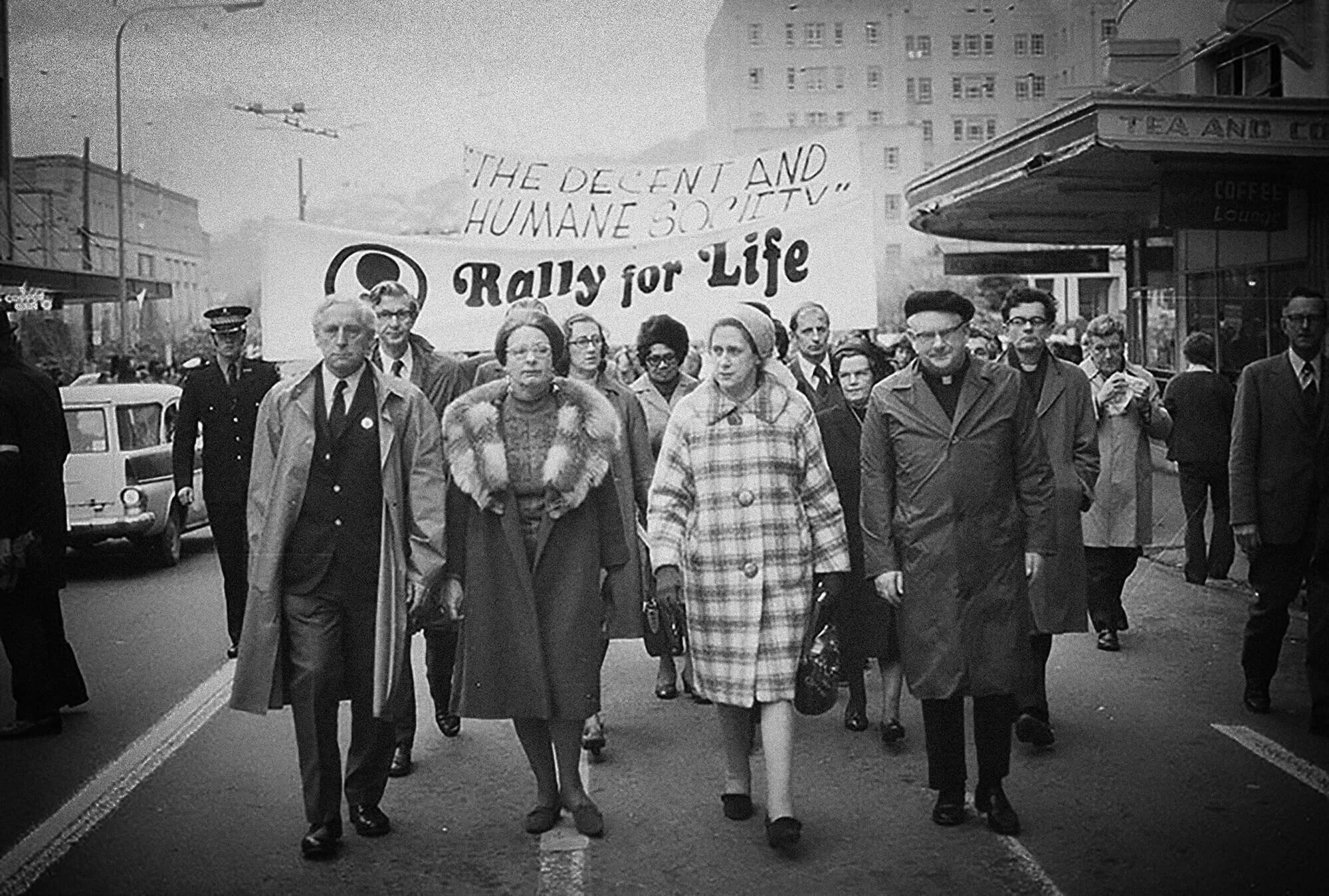
“An anti-abortion march down Auckland’s Queen Street attracted an estimated 4,500 people.”
“40,000 members in 56 branches.
The anti-abortion campaign began with a national petition to Parliament, signed by 113,381 New Zealanders.”
“On September 26th, SPUC held a pro-life march in Auckland, attended by 5,000 participants.”
“45,000 people took part in a national pro-life vigil called ‘Life Chain’, organised by churches.”
“SPUC was rebranded to Voice For Life”
“500,000 Missing Babies
2016 marked the tragic milestone of 500,000 unborn children killed by abortion in New Zealand since the first abortion clinic opened in 1974. VFL ran a nationwide advertising campaign; 500,000 Missing Babies.”
“Launch of March for Life in Wellington
The first March for Life was held in Wellington, hosted by a coalition of pro-life organisations including Voice For Life. Positioned near Parliament, the event aimed to engage directly with lawmakers and contribute to the national conversation around abortion law reform.
”
“Social Justice Tour
In May 2018, Voice For Life hosted international speaker Bryan Kemper from the U.S, and Hillary Kieft from Hillary’s Law on a Social Justice Tour over seven different regions.”
“Booties Project
On Wednesday, 25 July 2018, 13,285 pairs of booties were displayed on Parliament lawn as a public memorial of 13,285 preborn children aborted the year before in 2017. Thousands of people from all over New Zealand, knitted these baby booties in remembrance of the lives lost to abortion.”
“In November 2018, a new campaign called We Deserve Better was launched to introduce a new conversation about abortion from and by NZ women.”
“Voice For Life celebrates 50 years of advocacy with the launch of its new brand.”
“Voice For Life launches Voice for the Vulnerable resource.
In March 2020 the NZ Parliament passed the Abortion Legislation Act. This legalised abortion-on-demand right up to birth by striking down our previous law which only allowed late term abortion when two doctors agreed it was necessary to save the life of a mother or to prevent serious permanent harm to her mental or physical health. Vote for the Vulnerable allows you to find out how MPs and parties voted, and to send them a message letting them know how their vote in March is now going to be informing your vote in the upcoming election.”
“End of Life Choice Act Referendum
New Zealanders voted in a binding referendum on whether the End of Life Choice Act should come into force. The result was a decisive shift in national law and culture, with 65.1% voting in favour and 33.7% opposed.
”
“November 7 – Assisted dying comes into force
As the End of Life Choice Act took effect, Voice For Life marked the day with a national prayer initiative, calling for reflection, prayer, and support for vulnerable people in response to the legalisation of assisted dying.”
““Pulse” podcast launched
Voice For Life launched its “Pulse” podcast, featuring interviews, commentary, and discussion on key life issues, expanding its media presence and public engagement.”
““My Buddy, My Voice” campaign launched
Voice For Life launched the “My Buddy, My Voice” campaign to give a voice to men, grandparents, and others impacted by abortion. The initiative focuses on helping individuals process grief, guilt, and regret, while offering support, healing, and hope to those affected.”
“First Review of the End of Life Choice Act
The first statutory review of the Act was completed in 2024, three years after it came into force, assessing how the law was operating and identifying areas for potential change. The review found there was a major strain on health practitioners as only a small number were willing to participate.”
“First Youth Activ8 Camp
The first annual Youth Activ8 Camp (sponsored by Voice For Life) was launched, bringing together young people for training, leadership development, and engagement on pro-life issues. The camp marked a key step in equipping the next generation of advocates.”
“March for Life moves to Auckland
The national March for Life (co-organised by Voice For Life) was relocated to Auckland, bringing the event into New Zealand’s largest city. The annual public demonstration where people gather to advocate for the protection of human life, particularly the unborn, was moved, marking a strategic step to increase visibility, accessibility, and public engagement—placing the pro-life message at the heart of the country’s main population.”
“South Island Youth outreach tour
Voice For Life delivered a South Island Youth Tour across multiple locations including Oamaru, Dunedin, Gore, and Cromwell. The week-long tour engaged high school students through speaking events and discussion, expanding youth outreach and nationwide engagement. ”